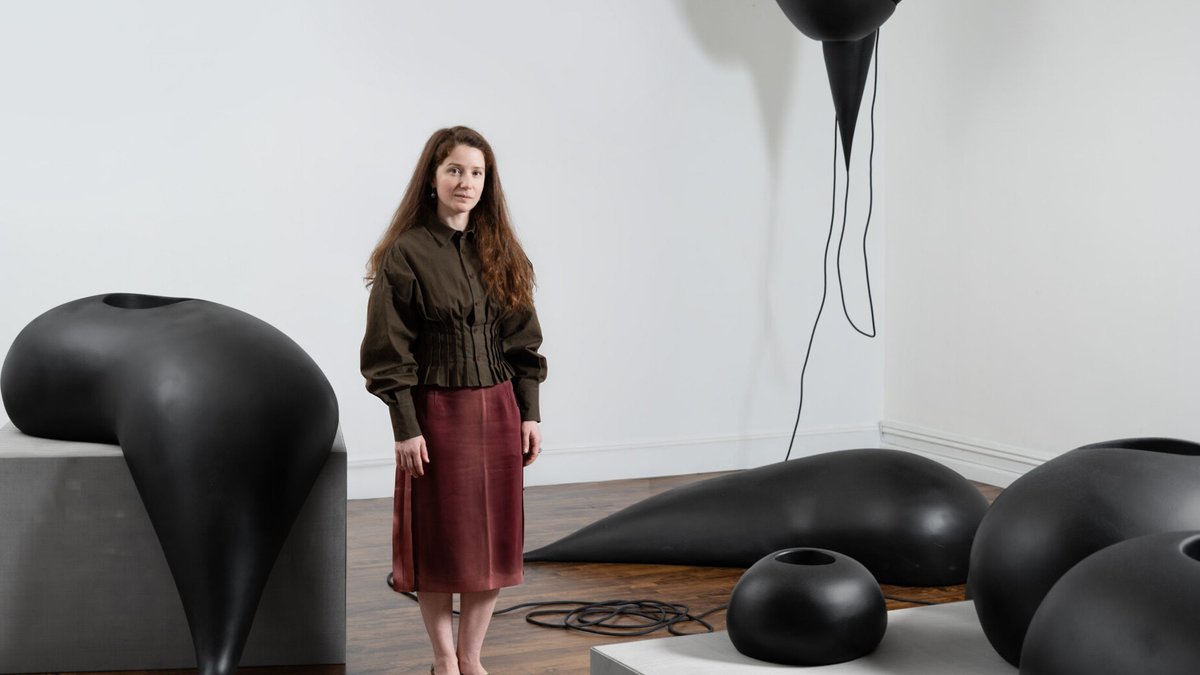
At the intersection of art, science, and finance, Sarah Meyohas, a conceptual artist and technologist, creates works that probe the boundaries between living and artificial systems, as well as our understanding of intelligence and agency. Her projects often incorporate emerging technologies to challenge these concepts.
In 2015, Meyohas introduced Bitchcoin, a pioneering cryptocurrency linked to the ownership of her physical artwork, predating Ethereum’s launch by several months.
A Unified Whole: Gesamtkunstwerk
Meyohas’s artistic approach is influenced by the concept of Gesamtkunstwerk, a German term referring to a “total work of art” that integrates multiple disciplines into a cohesive entity. Through discussions with scientists, she gained insights into how their research blurs the lines between the biological and the technological, leading to a deeper understanding of this approach.
As she notes, “Learning about their work consistently evoked a feeling that our categories of life, computation, intelligence, and agency were becoming increasingly unstable.”
Meyohas, a native of Manhattan, holds a B.A. in international relations from the University of Pennsylvania and a B.S. in finance from the Wharton School. She later earned an MFA from Yale, further solidifying her foundation in both art and finance.
Meyohas has been recognized as one of Forbes’ 30 Under 30 and has exhibited her work at prominent institutions, including the Centre Pompidou in Paris, the ICA in London, and the New Museum in New York.
Read Also: Lessons Learned While Hosting a Design Podcast
Phase Transition: An Exploration of States
Her latest installation, Phase Transition, debuting with Marianne Boesky Gallery as part of Zero 10 at Art Basel Miami Beach, explores the moment when matter transitions from a liquid to a solid state. Meyohas explains, “The sculpture holds both states simultaneously: the solid body is a form that has arrived, while the ferrofluid inside remains in motion, still becoming.”
The concept for the work emerged from an unexpected image.
This initial vision evolved into a series of black, rubbery, organic forms that sprawl across mesh bases, droop down walls, and hang from suspended wires. Windows cut into several structures reveal glass tanks filled with ferrofluid, a liquid containing nanoparticles that respond to magnetic fields.
A Network of Interacting Entities
Programmed magnets beneath the tanks direct the ferrofluid into shifting patterns, while synthesizers housed in the mesh pedestals translate those movements into sound. What began as a singular sculpture evolved into a network of communicating bodies.
Meyohas observes, “They could become a social system, with relationships, affinities, disagreements, and moments of consensus.” The installation implies a conversation with emotional contours that can be sensed but not fully understood.
This ambiguity is reflective of questions surrounding a future where artificial intelligence systems communicate increasingly among themselves, potentially in ways that are inaccessible to humans. As Meyohas notes, “We may find ourselves increasingly on the outside, observing exchanges between intelligences whose internal logic we can’t access.”
Read Also: Common Septic Tank Problems and the Best Ways to Address Them
Neuroscience research also plays a role in shaping the atmosphere of the work. Meyohas aims to evoke the experience of observing an experiment, capturing the hum of equipment, the clinical posture of observation, and the beauty of witnessing something operate just beyond full comprehension.
Meyohas’s Background and Investments
Beyond her artistic practice, Meyohas invests in companies aligning with her ethical and aesthetic interests, including Sita Bio, which develops artificial womb technology, reflecting her exploration of emerging technologies and their intersection with art and science.
Influences Behind Phase Transition
Meyohas cites three key influences that shaped Phase Transition:
Michael Levin, a developmental biologist at Tufts University, has made significant contributions to the study of bioelectricity. His idea that problem-solving occurs in tissues and groups of cells, rather than solely in the brain, has altered Meyohas’s perspective on matter. Levin’s lab is also credited with creating xenobots, tiny living machines composed of frog cells that can move and organize themselves.
A visit to the Teshima Art Museum, designed by architect Ryue Nishizawa and artist Rei Naito, served as an inspiration for Meyohas. On a rainy day, the museum’s unique design allowed water to bead and move across the concrete floor, giving the appearance of acting with its own will.
The communication patterns of sperm whales, which use codas or short patterns of clicks, also influenced Meyohas. Researchers with Project CETI discovered that these codas vary in rhythm and tempo, resembling a phonetic alphabet, yet the meaning behind these communications remains unknown.





Leave a Reply