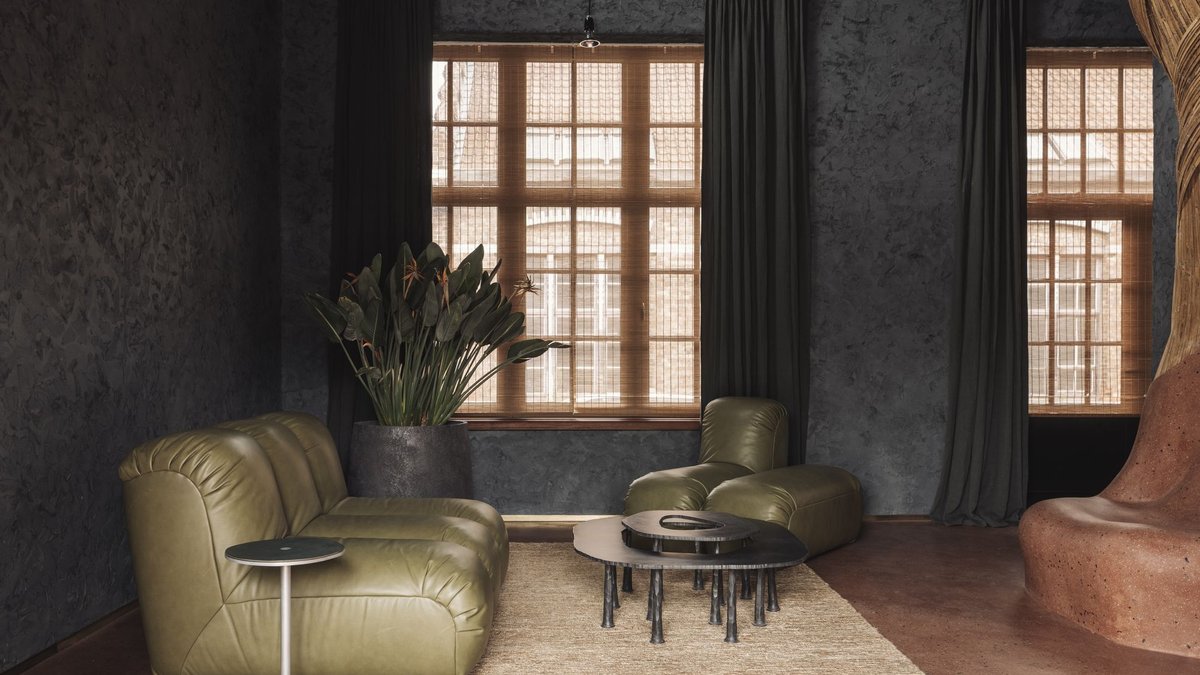
In a converted brush factory on the edge of Bruges, a new kind of hospitality project has opened—one that refuses to settle into familiar categories. Jonojé, the latest work from Belgian design studio Studio Loho, is a six-suite bed-and-breakfast that also functions as a gallery, photo studio, and living laboratory for the studio’s experimental approach to materials.
A building that doubles as a manifesto
The space spans more than 1,000 square meters of a listed industrial building, including a private residence for the director and a garden of 1,250 square meters. It’s less a hotel than a total environment, one that immerses visitors in the aesthetic and philosophy of the studio behind it.
Each of the six suites measures 75 square meters and carries its own distinct atmosphere. The design draws from a deep archive of techniques developed in-house: walls finished with organic plaster, freestanding ceramic shower cubicles, clay washbasins, and custom ceramic light switches created in collaboration with Maison Kallis. The Roku suite features bamboo-slat structures, while other floors display graphic patterns made from repurposed clay residues—waste transformed into ornament.
The centerpiece, however, is the ceramic bathtub. Molded and fired from a single piece of clay, it’s the object that first brought Studio Loho international attention. Its presence in Jonojé shows the studio’s broader ethos: a tension between simplicity and the sculptural, between comfort and the deliberately unsettling.
Beauty that resists easy labels
Founded in 2017 by Karel Loontiens and Jo Hoeven, Studio Loho operates out of workshops in Bruges, where they produce objects, surfaces, and one-off pieces—often in collaboration with artists like Sharon Van Overmeiren. Their work prioritizes longevity over disposability, crafting pieces meant to be cherished for generations rather than discarded.
Related: Bankston and For Scale Argue for Touch in Two Cities
“We believe in a renewed vision of interior design,” Loontiens and Hoeven said. “The rooms of a home are no longer purely functional; they become canvases for expression—places of beauty and comfort where form and function meet in harmony.”
The question of whether Jonojé is beautiful or ugly misses the point entirely. The project isn’t designed to fit neatly into either category. Instead, it pulls visitors into a space where the familiar is constantly disrupted—where a shower cubicle might double as a sculpture, and a bathtub feels like a relic from some future civilization.
That discomfort, intentional or not, might be the most compelling part of the experience. The studio isn’t just selling a place to stay; it’s inviting guests to step inside a world where design is as much about provocation as it is about hospitality.
Photography of the project was handled by Tijs Vervecken.



Leave a Reply